Quick Answer
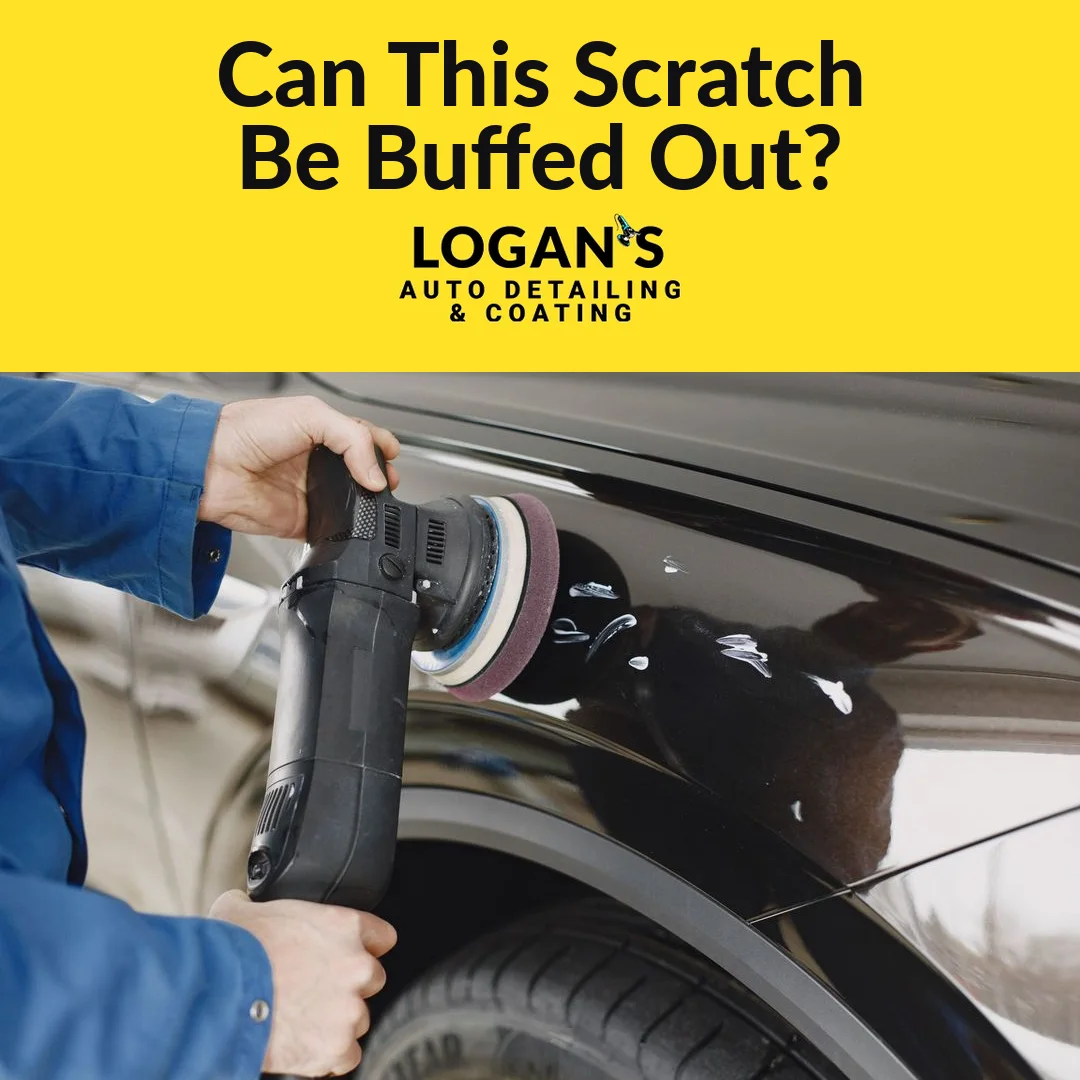
A car scratch can be buffed out if it is only in the clear coat, the transparent top layer of the paint. Run a fingernail across it: if your nail doesn't catch, it almost always polishes out. If it catches lightly, it can usually be made much less visible. If it catches firmly, or you can see grey primer or bare metal, polishing won't remove it and it needs touch-up paint or a body shop.
In Los Angeles, a full-car polish (paint correction) at our Van Nuys shop costs $600–$900 for a 1-step and $600–$1,500 for a 2-step, depending on vehicle size. A single scratch or one scuffed panel is fixed with spot correction, priced after we've seen it. The inspection is free.
Most scratches people bring us turn out to be shallower than they look. The rest of this guide is how to tell which kind you have before you spend money on the wrong fix.
What a scratch actually goes through
Car paint is a stack of thin layers. From the top down:
- Clear coat. Transparent, glossy, and thinner than a sheet of printer paper. It takes almost all the daily abuse: car washes, dust, keys brushing past, branches.
- Base coat. The color.
- Primer. Usually grey or white. Its job is to help paint stick to the panel.
- The panel. Steel or aluminum on most of the body, plastic on most bumpers.
Polishing works by removing a tiny amount of clear coat around the scratch until the surface is level with the bottom of it. If the bottom of the scratch is still in the clear coat, the scratch disappears. If it has gone into the color or below, there's nothing to level down to. You'd have to remove the color itself, which nobody should do.
That's the whole decision. Everything else is working out how deep the scratch goes.
The ten-second test: is your scratch in the clear coat?
You can do these two checks in a parking lot.
1. The fingernail test. Wash or wipe the area clean, then drag a fingernail slowly across the scratch, at a right angle to it.
| What your nail does | What it usually means | Polishable? |
|---|---|---|
| Glides straight over | Clear coat only | Yes, almost always |
| Catches lightly | Deep in the clear coat, or just into the color | Often much improved, not always fully gone |
| Catches firmly, like a groove | Through the color to primer or metal | No. Needs paint |
2. The wet test. Spray a little water or quick detailer on the scratch. If it nearly vanishes while wet and comes back as it dries, the scratch is in the clear coat. Water fills it the same way polishing levels it. If it stays plainly visible when wet, it's deeper.
Then look inside it. On a colored car, a scratch that still shows the car's own color at the bottom is usually fixable by polishing. If you see grey or white primer, or shiny bare metal, it's through.
These tests are a good guide, not a guarantee. Under inspection lights, a detailer can see how much clear coat is left around the scratch, which is what decides how far it's safe to go.
What each kind of damage needs, and what it costs in Los Angeles
| Damage | Nail test | The right fix | Price at our Van Nuys shop |
|---|---|---|---|
| Swirls and spider-webbing across the whole car (brush car washes) | Doesn't catch | 1-step paint correction | $600 small, $750 medium, $900 large |
| Heavy swirls, many scratches, oxidation, water-spot etching | Doesn't catch, or barely | 2-step paint correction | $600–$1,000 small, $700–$1,200 medium, $800–$1,500 large |
| One or two light scratches, a scuffed bumper corner, paint transfer from a pole or another car | Doesn't catch | Spot correction | Priced at the free inspection |
| A single deeper scratch, color still showing | Catches lightly | Spot correction, sometimes wet sanding first | Quoted on the car |
| Through to primer or metal, rock chips | Catches firmly | Touch-up paint, or a panel repaint at a body shop | Not a polishing job |
| Clear coat peeling, flaking or turning milky | Not a scratch | Repaint | Not a polishing job |
Both paint correction stages include a full wash, iron removal and a clay bar first, because polishing over grit grinds it into the paint. The 2-step also includes our full exterior detail. Prices and what each stage removes are broken down in our paint correction cost guide.
Spot correction isn't bookable online because the price depends entirely on the panel and the damage. Bring the car in, or send a photo, and we'll tell you what it will take.
The good news: a lot of "scratches" aren't scratches
Some of the most common marks we see in LA come off completely:
- Paint transfer. Scraping a parking-structure pillar or another car's bumper often leaves their paint on your car. It sits on top of your clear coat, and polish lifts it off. If the mark is a different color from your car, this is very likely what it is.
- Scuffs on bumper corners. Usually rubber or plastic residue plus light marring. Mostly removable.
- Car-wash swirls. The spider-web circles you see in direct sun. They live in the clear coat, and they're exactly what paint correction is for.
- Marks that look like scratches but are etching. Hard-water spots and sprinkler marks can look like scratches from a distance. Our water spot guide explains which ones polish out.
When polishing is the wrong answer
We're a detail shop, not a body shop, and we'd rather tell you here than at the counter:
- Deep key scratches. A determined key usually goes through to primer. Polishing can soften the edges and make it less obvious, but it won't remove it. It needs paint.
- Rock chips. They're missing paint. Polishing levels paint; it can't fill a hole. Touch-up paint is the usual fix.
- Failed clear coat. Peeling, flaking or milky patches, common on older cars that have lived outdoors in the Valley sun, mean the clear coat has let go. Polishing makes it worse. The panel needs repainting.
- Gouges in plastic bumpers. If the plastic itself is cut, that's a body shop repair.
- Paint that has already been polished thin. Every correction removes a little clear coat. If a previous shop was heavy-handed, there may not be enough left to remove a scratch safely. We check this before we start.
At the inspection we'll show you, under the lights, what will come out and what won't, before you commit to anything.
Should you try a scratch remover from the auto parts store?
For one faint scratch that passes the nail test, a hand-applied scratch-removal compound is worth a try. Work a small area with a clean microfiber applicator and check your progress often. If nothing changes after a few passes, stop. More rubbing by hand mostly dulls the area around the scratch.
Skip these:
- Toothpaste. A random abrasive that leaves haze.
- Melamine "magic erasers." They're fine sandpaper. They'll dull clear coat quickly.
- Most scratch-filler pens. They fill the scratch with resin that looks good for a few washes, then washes out.
- A rotary buffer you've never used. Edges and body lines burn through fastest, and burnt clear coat means a repaint.
Why LA cars get scratched, and how to stop the next one
Most of the scratches we fix in Los Angeles come from a short list:
- Parking structures. Tight ramps, concrete pillars and narrow spaces. Bumper corners and the lower doors take most of it.
- Brush car washes. The single biggest cause of swirls. A careful hand wash or a touchless wash avoids them.
- Dry-wiping dust. LA dust, and ash in fire season, is abrasive. Wiping it off with a dry towel or a duster drags it across the paint. Rinse first. Our wildfire ash guide covers the safe way.
- Street parking. Passing bags, bikes, keys and the occasional vandal.
- Narrow canyon and trailhead roads. Brush and branches leave long, fine scratches down the sides.
After a correction, protection keeps the finish longer. A ceramic coating makes the car easier to wash without causing new swirls and resists sun and chemicals, but it's far too thin to stop a key or a rock. If you're coating anyway, check the package first: our System X Max G+ coating includes paint correction in the price ($1,600–$2,600 by vehicle size, with a lifetime warranty kept by an annual inspection and topper coat). The full comparison is in our ceramic coating cost guide.
Selling the car or returning a lease? Scratch removal is often the best-value thing you can do first. See our pre-sale detailing guide and our lease-return guide, which explains the credit-card test lessors use for scratches.
Frequently Asked Questions
Can a scratch that catches your fingernail be buffed out?
Sometimes partly, rarely completely. A nail that catches lightly usually means the scratch is deep in the clear coat or just into the color, and careful polishing, sometimes with wet sanding first, can make it far less visible. A nail that catches like a groove means the scratch reaches primer or metal and needs paint.
How much does car scratch removal cost in Los Angeles?
At our Van Nuys shop, a full-car 1-step paint correction is $600–$900 by vehicle size and a 2-step is $600–$1,500. A single scratch or panel is fixed with spot correction, priced after a free in-person inspection because it depends on the panel and the damage.
How can I tell if a scratch is only in the clear coat?
Two quick checks. Drag a fingernail across it: if it doesn't catch, it's almost certainly in the clear coat. Then wet it: if the scratch nearly disappears while wet, it's in the clear coat. If you can see grey primer or bare metal inside it, it's through the paint.
Can you remove a key scratch?
A light key mark that stays in the clear coat polishes out. Most deliberate key scratches go through to primer, and those need touch-up paint or a repaint. Polishing can still soften one so it's less noticeable, and we'll tell you honestly which kind yours is.
Do scratch remover products actually work?
On faint clear-coat scratches, a hand-applied compound can help. Scratch-filler pens mostly hide the scratch temporarily until it washes out. Toothpaste and melamine sponges tend to dull the paint around the scratch rather than remove it.
Does polishing out a scratch damage the paint?
Done properly, it removes only a few microns of clear coat, and the paint stays fully protected. Done badly, with too much pressure or a rotary on an edge, it can burn through. That's why a professional checks how much clear coat is left before polishing.
Will ceramic coating stop scratches?
No. A coating is extremely thin. It helps prevent wash-induced swirls by making the car easier to clean, and it resists UV and chemicals, but it won't stop a key, a branch or a rock.
Does insurance cover a keyed car?
Vandalism is usually covered under comprehensive coverage, subject to your deductible. Check your policy. If the scratch turns out to be in the clear coat and polishes out, the repair often costs less than the deductible.
Bring the Scratch In
The fastest way to an honest answer is two minutes under inspection lights. Bring the car to our Van Nuys shop and we'll show you what will polish out, what won't, and what it costs. The consultation is free, takes about thirty minutes, and you leave with a real number.
Book a Free Consultation · Request a Quote · Paint correction service page
Van Nuys, serving the San Fernando Valley and Greater Los Angeles. 5.0 stars, 100+ Google reviews.