Quick Answer
A pre-turn-in detail is worth it when your charges will be cosmetic — set-in stains, odors, scuffed trim, swirled paint. It is not worth it when the damage is structural: dents, tears, burns, curb rash and cracked glass get billed whether the car is spotless or filthy.
At our Van Nuys shop an interior detail runs $240–$340, interior + exterior runs $389–$489, and odor removal is $180 on its own. Book two to three weeks before your turn-in date, and get your lessor's pre-inspection first so you know what you're actually fixing.
First: get the pre-inspection, then decide
Most lessors offer a free pre-turn-in inspection several weeks before your lease ends. Take it. It converts guesswork into a written list.
Detailing before that inspection is backwards. You end up paying to clean things nobody was going to charge you for, and missing the one thing they will. Get the report, then bring it to us — we'll tell you which lines on it a detail actually addresses.
Your lease contract and your lessor's published wear-and-use guide are the reference point, not a blog post. Federal law requires end-of-lease charges to be disclosed in the contract, so the standard you'll be held to is written down somewhere. Read it before you spend anything.
What the inspector is actually looking at
Standards vary by lessor, but the exterior test is remarkably consistent across the major captive lenders — the credit card test. A standard credit card is about 3.375" × 2.125". Damage that fits under one is usually treated as normal wear. A scratch that penetrates the paint, or a dent, that's larger than that card is usually chargeable.
Inside, the pattern is different. Light staining on a driver's seat is normally accepted as ordinary aging. What gets billed is anything permanent: burns, rips, holes, and deep stains that have set into the carpet or upholstery — ink, bleach, a coffee spill that went untreated for a year. Odors, especially smoke, are their own category.
That split is the whole decision. One side of it is dirt. The other is damage.
What a detail genuinely heads off
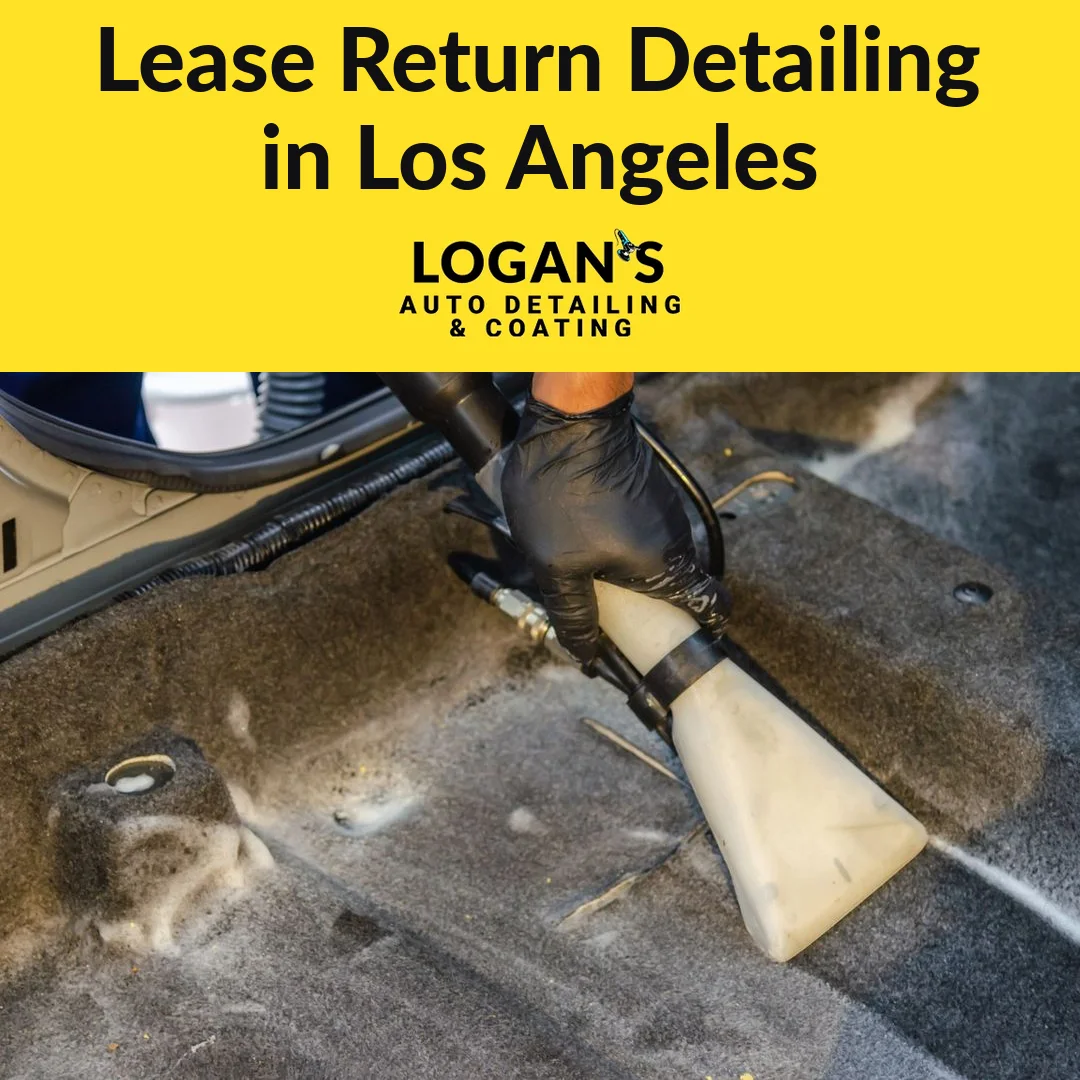
Set-in stains. This is the big one, and it's the one people assume is permanent. Hot-water extraction with enzyme pre-treatment lifts a great deal of what looks hopeless — coffee, soda, pet accidents, the dark halo around a child's seat. A stain that has been through two LA summers is harder than a fresh one, but "harder" is not "impossible."
Odor. Smoke, pets, gym bags, a milk spill under a seat. Ozone treatment plus a full interior clean removes the source rather than covering it. This matters because odor is subjective, and a car that smells is a car an inspector goes looking through.
Swirls and light scratches. Most of what makes LA paint look tired is swirl marks from automatic car washes, and those sit in the clear coat. Paint correction machine-polishes them out. A panel that looks scratched from three feet away can look flawless after correction — and scratches that don't penetrate the paint aren't chargeable anyway, so you're removing the thing that makes an inspector stop and look closer.
Wheels, trim and glass. Brake dust baked onto wheels, faded plastic trim, cloudy headlights. None of these are usually chargeable on their own. All of them make a car read as neglected.
The thing nobody writes down: inspectors are people, and they work through a lot of cars. A vehicle that presents as cared-for gets the benefit of the doubt on marginal calls. A filthy one invites a closer look. We can't promise you that effect and neither can anyone else — but it's real, and it costs $389 to have on your side.
What a detail will not fix
We would rather tell you this now than take your money and have you find out at the inspection.
- Dents. Any dent bigger than a credit card is chargeable, and no amount of polishing removes one. You want paintless dent repair, which is a different trade.
- Scratches through the paint. Correction removes defects in the clear coat. If you can catch a fingernail in it, or you can see primer or metal, that needs paint, not polish.
- Tears, burns and holes in upholstery. A cigarette burn or a split seam is damage. Upholstery repair specialists handle those; we don't.
- Curb rash on wheels. Cosmetic wheel repair is its own speciality.
- Cracked or chipped glass. Windshield chips are usually chargeable and usually cheap to fix — through a glass shop, before you turn in.
- Worn tires. Most lessors set a minimum tread depth, commonly around 1/8". No detail changes that number. Check it early; tires are one of the largest and most predictable lease-end charges.
- Missing keys, mats, cargo covers or headrests. Replace them yourself. Dealer prices for these are not kind.
If your inspection report is mostly this list, save your money on detailing and spend it on the right specialists.
What it costs here
| Service | Small (coupes) | Medium (sedans, crossovers) | Large (SUVs, trucks) |
|---|---|---|---|
| Interior Detail | $240 | $290 | $340 |
| Exterior Detail | $180 | $230 | $260 |
| Interior & Exterior — the usual lease-return choice | $389 | $429 | $489 |
| Odor Removal (standalone) | $180 | $180 | $180 |
| Paint Correction — if swirls are heavy | from $600 | from $700 | from $800 |
The interior + exterior package is what most lease returns need: the inside gets extracted and steam-sanitised, the outside gets decontaminated, clayed and protected. Interior detail takes 3–5 hours, the combined package 6–9 — we usually keep the car for the working day.
Does the maths actually work?
Sometimes yes, sometimes no, and it depends entirely on your inspection report.
Reported charges for interior cleaning commonly land in the $100–$200 range, cigarette burn repair in a similar band, and torn leather considerably more. If your report lists one light stain, a $429 detail to avoid a $150 charge is a bad trade on money alone.
Where it turns clearly positive:
- Several interior charges at once. Stains plus odor plus grubby carpets add up past the cost of fixing all of them properly in one visit.
- Smoke odor. Frequently one of the more expensive interior charges, and one of the most reliably fixable.
- Heavy swirling on a dark car. Black and dark grey paint shows every wash mark. Correction is a real cost, but so is a paint-related charge.
- You're buying the car out. Then it isn't a charge-avoidance calculation at all — you're keeping a car you'll be glad is clean, and coating it while the paint is corrected makes far more sense than doing it later.
Where it's usually negative: a car that's already tidy, with one small chargeable item, and no odor. Tell us that on the phone and we'll say so.
When to book
Two to three weeks before turn-in, after the pre-inspection. That's enough runway to get dents, glass or tires handled by the right specialists if the report calls for them, without leaving the detail so early that the car gets dirty again before it's seen.
Don't leave it to the last three days. Lease-end season clusters, our combined detail occupies most of a working day, and the appointments nearest the end of the month go first.
Frequently Asked Questions
Will detailing guarantee I avoid wear and tear charges?
No, and be wary of anyone who says otherwise. Detailing removes dirt, stains, odor and clear-coat defects. It cannot remove damage, and the final call belongs to your lessor's inspector against your contract's standards. What it does is take the cosmetic items off the table.
Should I detail before or after the pre-inspection?
After. The inspection tells you what's actually being charged, so you only pay to fix what matters. Detailing first often means cleaning things nobody was going to bill you for.
My car smells of smoke. Is that fixable?
Usually, yes — that's exactly what ozone treatment plus a full interior clean is for, and smoke is one of the more expensive charges to leave in place. Nicotine staining on headliners and glass is a separate problem, and heavy cases don't always come back fully. We'll tell you honestly what we're seeing when we look at it.
The dealer offered to detail it for me. Should I let them?
You can, but understand what you're buying. Dealer reconditioning is priced to prepare a car for resale, not to argue down your charges, and it happens after the inspection that determines them. Doing it beforehand, independently, is the version that can change the number.
I'm buying my leased car out. Is a detail still worth it?
More so, arguably. You're not avoiding a charge, you're starting ownership of a car whose paint has three years of wash marks in it. That's the right moment for correction and a ceramic coating — the paint is already being polished, so the protection goes on properly.
Do you do paintless dent repair or wheel repair?
No. We're a detailing and coating shop. If your report lists dents, curb rash or torn upholstery we'll tell you plainly that those need a different trade, so you can book the right people in time.
Get a Straight Answer Before You Spend
Bring us your pre-inspection report. We'll tell you which items a detail actually addresses, which ones need somebody else, and whether the numbers work at all for your car — before you book anything.
Book Your Lease Return Detail · Request a Quote · See all packages and prices
Van Nuys, serving the San Fernando Valley and Greater Los Angeles. 5.0 stars, 100+ Google reviews.